GM503A
Magnetic properties toroidal boxed magnetic cores from amorphous and nanocrystalline alloys
GAMMAMET® 503A
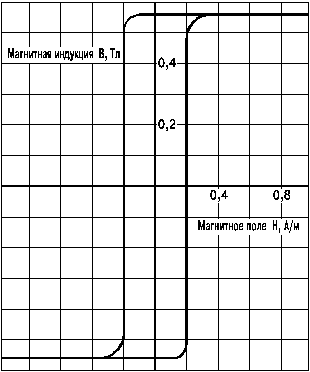
Magnetic cores GAMMAMET® 503А are made of a ribbon by thickness 25 microns with nanocrystalline structure. The ribbon is produce by means of fast incandescence from an alloy on the basis of Co. After thermal processing in a longitudinal magnetic field magnetic cores have high rectangular loop of a magnetic hysteresis and low specific magnetic losses.
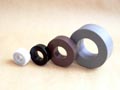
Magnetic cores may be produced with any standard sizes with external diameter up to 600 mm, with internal diameter not less than 8 mm, proportional 5 mm at height and are delivered in protective containers.
Sizes list of magnetic cores in protective containers you can see in Table 1. Weight and geometrical sizes of toroidal boxed magnetic cores
All magnetic cores have a class of thermal stability A (105°C). At will of the customer also magnetic cores may be produced with class F (155°C).
Full service life of magnetic cores - 30 years.
Magnetic cores GAMMAMET® 503А replace soft magnetic alloys Fe- and Ni- alloys and ferrite with a rectangular loop of a magnetic hysteresis. Next table of magnetic parameters is agreed with specifications ТУ 1261-030-12287107-2007:
| Magnetic core | Squareness ratio Kp10, not less | Coercive force, A/m, not more | Magnetic induction B800, T, not less |
|---|---|---|---|
| GM 503A | 0,9 | 0,6 | 0,55 |
Use area: magnetic amplifiers, pulse transformers, magnetic keys.
GAMMAMET® owns following patents of Russia which are used at manufacture of magnetic cores GM503А: 2098505, 2115968.
The detailed information about magnetic properties of GM503А can be found in the book: Starodubtsev J.N., Belozerov V.J. "Magnetic properties amorphous and nanocrystalline alloys"
| Magnetic induction of saturation В800 | 0,58 T |
|---|---|
| Maximum permeability | 1500000 |
| Coercive force | 0,2 A/m |
| Squareness ratio Br/B800 | 0,92 |
| Saturation magnetostriction | <0,2×10⁻⁶ |
| Specific electroresistance | 1,2×10⁻⁶ Om×m |
| Density | 7700 kg/m3 |
| Curie temperature | 260°C |
| Temperature of crystallization | 530°C |
| Specific magnetic losses at frequency3<f<200 kHz | |
| P = 9×10⁻⁵f1,4Bm1,5 (W/kg) | |
| f – frequency (Hz), Вm – maximal magnetic induction (T) | |
Loop of a magnetic hysteresis
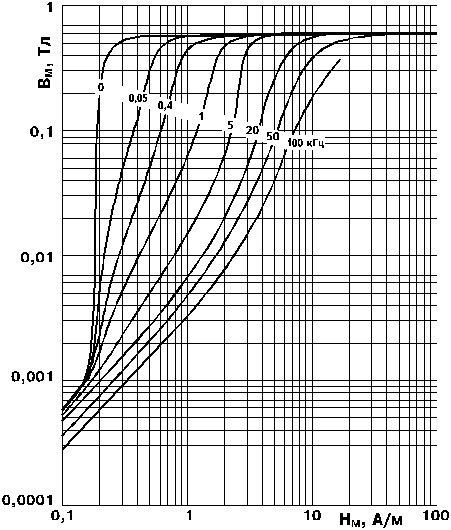
Dynamic curves of magnetization
By digits on curves designate frequency in kHz. The curve f = 0 corresponds to the basic curve of magnetization
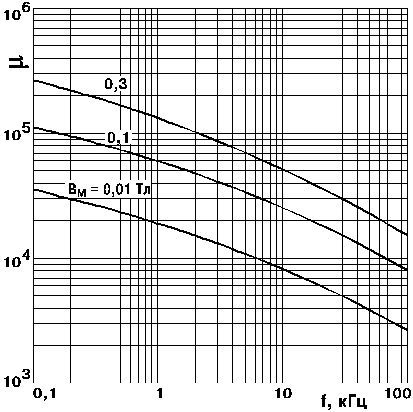
Magnetic permeability at the fixed maximal magnetic induction